Machismo
Machismo is alive and well in Cuba. Men greet each other with a forceful slapping handshake (women get a kiss but only on one cheek). The men in the towns look as though they have just come from the gym where they have been toning their pecs and abs and the women wear short skirts and are made up to the nines. In the country male headgear is a practical,large straw stetson. In the towns men would not be caught dead in such a thing and prefer a baseball cap.In the towns men seem to be clean shaven. In the country the prosperous ones sport luxurious black moustaches.....Now how is that for a barrage of generalisations?
Chambermaids
Chamber maids in hotels have devised a stratagem for ensuring that you do not forget to leave them a tip. Every day on your bed you will find an extraordinary elaborate towel sculpture with a gushing note wishing you a lovely day. The problem is that they use the towels from your bathroom and if you forget to collect them before you hop in the shower you have to drip across the floor to fetch them.
Christmas
For some reason the Cubans are so partial to their Christmas decorations that their Christmas trees are still well up into mid January.
Flowers
Although the bougainvillea and other flowers grow profusely in every hedgerow and on every wall, only plastic flowers in the hotels.
PR
Someone--maybe Fidel himself--has given the Cuban tourist officials lessons in hyperbole. To read the signs and brochures you would think that Cuba was the Garden of Eden returned. It is nice but it is best not to get yourself too excited at the written word.
Earplugs
Do not come to Cuba without earplugs. The chances are that your hotel will be in the main square next to a disco or bar which will be going strong at 2 am and thereafter the enebriated customer will continue the party in the street under yur window--last night it was a party of Russians but the Cubans are just as fond of the late nights and the rum.
If the party has finally finished by 5 am you have an hour to sleep before the birds begin. There are lots of birds in Cuba and the leafy central squares next to your hotel will attract huge flocks of chattering starlings.
Beer and water
I have not drunk so much beer for years. There are two brands. The light one is Cristal and the stronger one is Bucanero. Cristal is not bad and is cheaper than the mineral water which is a dreadful price in hotels and restaurants.
Friday, 13 January 2012

Thursday, 12 January 2012
Cuba Part 3--the countryside
I am posting this from the state-run internet office ( but no picture uploading --that will have to wait until I get to Puerto Rico I am afraid) in Santa Clara, site of the famous train derailment on 28 December 1958 which made Che Guevera the star he is. The city is full of gap year Che-admiring backpackers. I am staying in a hideous seven story mint green concrete block monstrosity which is the only tourist hotel. However even it has Che connections (see below).
I have had lots of adventures since I left Havana on Monday--flat tyres, backyard repairshops, mountain passes on dirt roads, wandering pigs and goats on the road, hustlers galore, and lots of hitch-hikers --nine today if you count the 4 week old baby on his way to the clinic in the main town with his parents.
Hitchhiking is a way of life for Cubans. This is understandable when you discover that fuel costs $70 a tank for a small hatchback and the average monthly salary is $25. Aside from hitchhiking, horse and cart or just horse seems to be the favourite mode of transport. Apparently at the beginning of the "special period"when the Soviet Union collapsed and left Cuba to find another sugar daddy, Castro imported bicycles from China. However I get the impression that bicycles are not regarded as manly since you don't see nearly as many as one would expect. People seem to prefer the horse or the hitchhike rather than the bike.
The land is beautiful: lush and fertile. The light in Cuba seems to give a soft golden glow to everything. It is not harsh and does not dazzle as it dos on many Caribbean islands. Although there are ranges of low mountains (about 2500 to 3000 feet is about as high as they get) there are vast expanse of flat or rolling country and wide valleys between the rolling hills, ideal for farming.
Cuba has 11 million people and a quarter of them live in Havana. This means that the countryside is sparsely populated. And Cuba is a very big island. Cuba is primarily a rural and diversified agrarian economy, the like of which you don't see much in the first or second world any more. There does not seem to be a lot of manufacturing, even around Havana, although I have seen a few factories belching smoke near Cienfuegos on the central south coast. The towns outside of Havana are not large--200,000 or so.
You can see that the Cubans are excellent farmers: the fields are expertly ploughed with a brace of oxen and a hand plough and teh rows of crops are neatly planted and flourishing. The soil is bright red in the west in Pinar Del Rio and a rich brown here in central Cuba. The vegetation is subtropical to tropical--sugar cane, pineapple, bananas, mangoes, guava, papaya are all grown as crops. The royal palm, the national tree, is everywhere. Pigs,cows, and goats abound--grazing beside the road or tethered under a tree in the yards, all the picture of health. Pork seems to be ther favourite meat and every little house in the country has a pig or two squealing and snuffling and snorting in the yard--all "organic" of course, not a battery farm to be seen. The oxen are without exception beautiful animals and clearly treasured because without there efforts there would be no ploughing and no crops.
The only animal which does nto seem to be so well cared for are the horses. Horses (and a few mules), whether ridden or used with a buggy or a cart, seem to be the primary means of transport for short distances (longer distances are done by hitchhiking or on the black diesel-belching rural buses), and heavy goods are moved in enormous 1950s vintage trucks. I've only seen one what I would call modern transport truck since I arrived. Some horses are beautifully cared for with shiny coats and brushed manes--especially those ridden by the cowboys. (I am sure that is not what they call themselves but that is exactly what they look like with their leathery tanned skin and cowboy hats.) Other horses however are quite pitiful creatures with matted coats and bony hips and ribs.
Housing in the villages and the countryside is very "basic"--no electricity or running water of course, and many are just wooden shacks. The more well to do have brick or more likely concrete block one story square bungalows (although to call them bungalows is too grand for what they are). Many are thatched with palm fronds, expecially in the west. But most have a front porch set with chairs to sit on and watch the world go by. It is likely that the outsides of these houses is deceiving. In the towns the streets are lined with single story row houses which look very unprepossessing. However when you look in their windows at night or through their open doors you see spacious rooms with antique mahogany furnitues and lace tablecloths--and more often than not a colour TV on at full blast. I also had the interesting experience of visiting a suburban house to have my flat tyre fixed (that is another long story!) and was able to see first hand the extensive back garden behind the modest concrete block house, and the tyre repair workshop on the back patio and the simple but comfortable furnishings.The workshop reminded me of the one my father used to have in our backyard in Canada when I was a child. And that was in the 1950s.
And that says it all. Aside from the televisions it dosn't seem that anything has moved much since 1959. Cuba must be one of the countries with the least penetration of cell phones. I have only seen two since I arrived.electricity is in short supply leading to a very eco-friendly lifestyle--very little street lighting and almost no neon, houses dimly lit with one lamp and a low energy light bulb.
It is all rather a culture shock, even for me. But for me it is a little of deja vue because there are things that I haven't seen since I was a child.
You read that Castro succeeeded in raising the literacy of the population to over 95% in a matter of a few years and instituted a first class health service. Well I think that remains the case. There is a school every few blocks and looking inside the doors and windows of the schools you can see that hey are humming with orderly activity and classrooms full of children listenting attentively. The childrens are neatly uniformed in their burgundy or gold skirts or trousers, white blouses or shirts and their blue or burgundy neck scarves. They seem enthusiastic and keen ---I had the privilege of observing a group of school children with their teachers at a special entertainment. None of your bored blase sneering cynical western children here--they participated with enthusiasm and paid rapt attention,ignoring the goggling tourists. Health clinics also abound in every small town. I observed a couple of young western backpackers one of whom had cut his foot. He was whisked off by a white coated nurse for treatment, no questions asked.
What Cuba does not have is natural resources. The cruel vagaries of tectonic plate shifts which bestowed vast oil riches n Venezuela and in the Texas Gulf have left poor little Cuba with none. And that is its Achilles heel. Without oil it cannot fuel its transport or light its buildings or run its factories and so is destined to remain an agrarian society. Even those countries friendly to Cuba must think twice before sending in supplies--any ship that docks in Cuba is barred from American ports for 6 months.
Back to Santa Clara, the site of the decisive battle in the Revolution when Che Guevera and his small band derailed a government train carrying mercenaries and armaments which were intended to take on Fidel Castro and his band of revolutionaries in the Sierra Maestra near Santiago de Cuba. The day after the derailment Batista fled to the Dominican Republic and the revolutionaries made their triumphant way to Havana. The entire town of Santa Clara, at least from a tourists perspective is a shrine to Che. There is a museum of boxcars on the site of the derailment. On the outskirts of the town is a huge memorial with a mausoleum where Che's remains are, recovered from Bolivia where he was shot in 1967 on CIA orders. Even my ghastly hotel has bullet holes in the walls. At the time of the Revolution it was brand new and the height of 1950s luxury so that is where the military officers stayed.
There is no doubt that Che--and Fidel--must have been tremendously charismatic in their day and they represented --or caught--the mood of the time. But there is nothing on show that postdates 1970. How much longer the Cubans will be prepared to live off past glories remains to be seen. However Fidel has pulled rabbits out of hats before--for example the Pope's visit in 1998 at the worst depths of the "special period" of deprivation after the abandonment by the Soviet Union, was a public relations master stroke and typical of the Castro brothers' sense of good timing. I wouldn't be surprised if Fidel has one more rabbit waiting to be produced with a flourish.
Monday, 9 January 2012
Cuba part 2--Revolution, renovation and resolution
Here are some further musings on Havana and other useless bits of information from my few days in Havana. I pick up my rental car on Monday and leave for the central and eastern parts of Cuba. I could have done with at least one more day here in Havana. I spent yesterday on a coach tour to the western end of the island: Pinar del Rio and Vinales. It was fascinating but did reduce my time in Havana. I think I will probably come back another time, not least because I am very curious to know how the complexities that I mentioned in my last post are resolved.
By the way, I don't know what internet connections I will have once I get out into the country so you may not hear from me for a while.
Revolution
In Havana and indeed in the countryside, it is impossible to escape the impact of the Revolution. Slogans abound, even in the most rural areas. Since there is no other advertising (I can't tell you what a welcome absence that is!) you really do notice them: "Revolution or Death", "Patria e Muerte", "Viva Fidel; Viva Raul" as well as posters trumpeting the 53rd year of the Revolution. And of course the million faces of "Che" on every possible flat surface and item of clothing.
But even the Museum of the Revolution has no exhibits after 1980. And the evidence of the consequences of the fall of the Soviet Union and the continuing US embargo is everywhere to be seen. Street lights are dim and used sparingly . Food and goods in the local stores are unattractive and seem to be sold out by late in the day. The theatre where I attended a ballet performance last night is in a terrible state of repair. The state of the sidewalks and streets would give a Health and Safety Inspector a heart attack. Nothing works as it should. Service is normally awful. Private enterprise is very small scale and constantly being harrassed. I've already mentioned the dilemma of the dual economy.
Transport for the people is limited to dilapidated buses which make Delhi's look flash, or to bicycle trishaws and the venerable old 1950s cars, or the much less evocative ancient Ladas. I haven't seen so many motorcycles and sidecars since the 1950s in England. It does look as though China is starting to fill the gap, though, since all the tour buses are brand new Chinese manufactured coaches.
But it is when you get out of Havana that you really get a shock. In yesterday's 12 hour excursion to the most lush farming land in the country I saw only one tractor. Fields are ploughed with oxen and hand held plough. Public buses in the towns are horsedrawn wagons. You are as likely to see a horse and buggy as a local car.
However people are managing . The fields are full of beautiful crops. Occasionally you get spectacularly good service with a warm and genuine smile. People are trusting---a credit card imprint is not the first thing you are asked for. The ballet theatre was full and with a knowledgeable and appreciative audience. People are out on the streets having a good time. On the whole people look pretty healthy, well dressed, and confident. Today was Sunday and the families were out in force, promenading , taking the children to the park or the museums.They grumble openly about the taxes and the rations without any apparent fear of consequences. Despite the difficulty of setting up any private enterprise people are doing so, albeit in a very small and rather amateurish way.
It is of course impossible to make any assessment in a matter of a couple of days, but I did not see any signs of imminent collapse. Nor, however, did I see any signs of a light at the end of the tunnel.
Baseball
Baseball totally absorbs the nation.There is even a section of one of the main parks where the baseball fanatics get together to argue about the teams and re-hash the latest game and the future prospects. Ironically the local sports channels report in detail on the US baseball scene.
Music
Yes it is everywhere, just like they say. And I like it. I really am not a fan of modern music in general and certainly not "celebrity" plastic stuff you get in shops, on the car radio and TV, leaking out of people's earphones. But the stuff here is genuine live music of all genres from classical to salsa and it is really really good--except of course the strolling restaurant musicians playing the obligatory Guantanamera over and over again.
Toilet seats
I was asked by a friend who was here 20 or so years ago, if they now have seats on the public toilets. The answer is no they don't.
Gays
From what I can see in the streets around the central area I am in, there is an open and pretty numerous male gay community in Havana.
Cold
It has been cold here since I arrived! I came expecting the same 30 degree temperatures that I had in the British Virgin Islands over Christmas, since Cuba is only a couple of hundred miles away and not much further north. But no, it has been hovering around the mid 20s and a lot lower at night and there is no heating in the houses or in our hotel. I've been glad I brought a coat and sweater!
Tourists
I was wrong in yesterday's post. There are some Chinese tourists here. I saw a party down in Vinales yesterday . They were riding horses and taking photos of each other with expensive cameras and generally having a great time. They lunched at the same place we did and they started to dance to the band --very well. I recall that when I was working in Beijing and out for an early morning walk in the park I was amazed to hear recorded western dance music and rounding a corner saw a group of Chinese men and women solemnly foxtrotting at 7 am. I believe it is regarded as an acceptable form of morning exercise and suitable alternative Tai Chi.
And I have also seen two parties of Americans, sleekly groomed and expensively dressed and HERE! How, I don't know. I wonder if I should tell Mitt Romney?
Miami Beach in Cuba
Yes that's right. The residential suburb of Vedado was built to be like Miami, right down to the grid pattern of Avenues called with letters of the alphabet and Streets with numbers. And the one story bungalows and car ports and yards are straight out of Miami circa 1955. In fact they are rather charming and the suburb is clearly a desirable area for Cubans to live since the houses and yards are well kept and the cars are nearly-new. Less desirable are the hideous sky scrapers and crumbling concrete shopping centres that were thrown up nearer the beach in the last heady days of Batista and his Mafia friends before the Revolution.
Food
They say that no one comes to Cuba for the food. I'd revise that to say people come to Cuba in spite of the food. It is as dire as they say. I can't quite put my finger on it but it is a combination of lack of imagination, very limited selection, poor ingredients, lack of seasoning, poor preparation, bad service. So not a whole lot of plus points there, is there? Gordon Ramsay! Jamie Oliver! Cuba needs you!
 |
Budding free enterprise |
 |
| The quirky decor of the paladare (privately operated front-room restaurant) Julia where I had a (mediocre) dinner |
 |
| Can you see a theme? I can't. These figurines were decorating the floor in the Paladare Julia. A shrine? But to what deity? |
 |
| Local bus transport in Pinar del Rio |
 |
| The dual economy, Pinar del Rio |
Sunday, 8 January 2012
--and more Havana photos
I have tons of photos but the connection is very slow so I cannot post all that I would like to at this time. I'll try to upload to Flikr in due course when I have a better connection. In the meantime here are a few more. Later I will do another post with my further musings on Havana.
 |
| Handy tip: Here's a way to use up your leftover cannons. |
 |
| This is "Havana Blue" |
 |
| Awaiting renovation |
 |
| Still waiting |
 |
| Too late |
 |
| Probably not worth saving |
 |
| A botched job |
 |
| The dilemma: Which should Havana choose? |
 |
| Maybe I shouldn't have mentioned the Revolution... |
 |
| A local bar |
 |
| street in Old Havana--note the bicycle rickshaws, the usual public transport for the locals in the narrow streets |
 |
| Fishing boats in the bay of Havana, looking over to Catillo del Morro |
 |
| Centre are the yellow cocotaxi, motor scooter powered. Right is the bicycle trishaw used a lot by the locals. Left the 1950s US gasguzzlers often used as taxis but also as ordinary private transport. The exhuberant Grand Theatre of Havana behind |
 |
| An armoured tractor, used in the Revolution. Ironically, the farmers don't have tractors any more and use oxen to plough their fields. |
 |
| The beautifully restored Plaza de la Catedral |
 |
| The lovely Plaza de Armas, built in the 1600s and now the home of the second hand book sellers. |
 |
| The sadly neglected Malecon |
 |
| Sunday afternoon--it's time to wash the car |
More Havana photos
 |
| View from Hotel Saratoga roof top |
 |
| The Capitolio--if it looks familiar, yes it is a copy of the Capitol Building in Washington! |
 |
| The Floridita, one of Hemingway's favourites for daquiris |
 |
| an unrenovated stairwell in Old Havana |
 |
| The restored interior courtyard of one of the colonial mansions in Old Havana |
 |
| The beautifully preserved and restored interior of the Taquechel which is still an operating pharmacy |
 |
| This building is an incongruous glass and concrete structure built in the 1950s on the site of the old university right in the heart of Old Havana. Rather than tear it down they have put a "wrapper" on it copying the design of the old university and turned it back into a university building. |
 |
| View into an unrenovated courtyard --note the infil of additional rooms |
 |
| Another beautiful renovation job--the building, not me! Note the stained glass at the right. This is "mediopunto", a specialist Cuban colonial buildings |
Saturday, 7 January 2012
Cuba part 1--first impressions

Havana-first impressions
It is always unwise to record one's first impressions because they usually turn out to be wrong---but that has never stopped me!
I am now in Havana, having arrived late Wednesday. On thing for sure--it's a complex place.
But the simple stuff first:
Yes the 1950s American gas-guzzlers really do still exist--the Pontiacs, the Dodges, the Chevies, the Chryslers. With their fins and their chrome and brightly coloured leather upholstery. Some convertibles, a few whitewalls. I had rather expected that they were part of the tourist hype and that I might see a few, strategically located to provide the tourists with photo opportunities. But no, they are still in common circulation. Many are taxis but a lot are still in private everyday use. They are in various stages of decay of course. Very few retain all their chrome. I suspect that there are almost none with their original bright coloured enamel paint jobs. But they are still there, in all their faded Detroit glory. That was a more colourful and exhuberant age. None of your milquetoast beiges and blacks and modest eco-friendly ways. No sir. I remember it well!
The Cubans are very partial to sky blue--their flag, their window shutters, their flag, their sea--and, yes, their sky. A more prosaic explanation is that it is a good colour for repelling mosquitoes.
Havana does seem to have an enormous number of museums covering every conceivable special interest from stamps to rifles to motor cars and from the Revolution to rum to playing cards to the fine arts. I can't say I saw crowds lined up to enter any of them---except for the Museum of the Revolution which I think it must be compulsory for all visitors to Havana to go through.
There are quite a lot of tourists in Havana, although only of a fraction of the number who fly in (the airport is chaos) and go directly to the beach resorts in Varadero. No Americans of course (although apparently some do come, by circuitous routes of course, to avoid the embargo---see comments later on its affect). A few Brits, more Canadians, plenty of Spanish, South Americans and Mexicans. A number of other Europeans, including some from the ex-Soviet Union as one might expect. Apparently there are increasing numbers of Chinese tourists although I didn't notice any. (China has of course invested in Cuba and has sold/given Havana its shiny new tour buses). It is interesting that virtually all the tourists no matter what their native language have to converse in English if they don't speak Spanish. Apparently English is mandatory at school. So far I haven't had too much problem with only my virtually non-existent Spanish--but wait until I get out into the countryside next week!
I'm in a lovely hotel, the Saratoga. It is very well located, opposite the Capitolio and so right on the edge of Old Havana but with the wide boulevards and green spaces of Centro. My room has 15 foot ceilings with two 12 foot wooden shuttered French doors leading out onto two small wrought iron balconies. Marble bathroom . Elaborate, colourful patterned tiled floor. The best sort of example of tasteful and meticulous restoration of a nineteenth century building. And a decadent roof top swimming pool with bar and restaurant and a magnificent view, which certainly wasn't part of the original hotel! But I quickly discovered that while the renovations are perfect, no one checked the water pressure and the fine marble tub takes forty five minutes to fill, a teaspoon at a time.
Which brings me to some of the more complex issues:
The restoration of Havana's wealth of 16th, 17th, 18th and 19th century Colonial-era buildings is a monumental task, and like painting the Forth Bridge it is unlikely ever to be finished. For example some of the earliest renovations are already now being redone. But it is certainly worth it. The restorations are meticulous and the results outstanding. This is due to the passionate and dictatorial committment of the city historian Dr Eusebio Leal Spengler who is sometimes referred to as the other Cuban "Maximo Lider" (Fidel Castro being the best known one!) Many of those buildings in Old Havana which have not been renovated yet clearly have "good bones" and will turn out well once they get to them. At least they have the wealth of old buildings to work with --most cities have torn theirs down, if they ever had them, and put up a parking lot. And the renovated buildings are not museum pieces or Disneyland recreations, but all are in daily use--although since many of them were mansions of the wealthy originally they do make ideal boutique hotels.
Sadly for many of these old buildings, particularly those along the seafront promenade, the Malecon, it is too late to renovate. They are truly past recovery I think. I found the Malecon (which is much trumpeted in the guide books) to be truly depressing. Such a magnificent seascape but absolutely no signs that it would receive any attention in time to save it. I really thought that there the only outcome must be demolition and rebuilding in a more people-friendly way . At present there is not a bench to sit on, not a cafe or even an ice cream van and a multi-lane highway wizzing along with not one single pedestrian crossing to get in safety across to the promenade.
Another problem. How do you choose what to renovate? Do you let the lovely 19th century buildings rot while you do the 16th century ones? More intractible are the dwelling houses. While it is relatively politically and socially uncontroversial to undertake the restoration of public buildings, it is not going to be easy to renovate the more modest but still elaborate houses which were built for one middle class family and now house many times that number of families. Where will the people go in the meantime?
There is a certain risk for individuals to undertake renovations themselves because it may attract unwanted attention of the authorities who will want to know where the money came from. Those who have renovated have done so with an eye to comfort and practicality not to architectural or historic integrity. Thus a gash in the outer wall to house an airconditioning unit and the original floor to ceiling shutters replaced with the Cuban equivalent of PVC windows.
Also, although the interior of the living quarters in these buildings are owned by individuals, the common parts are owned by the state. The "state" is a great lumbering bureaucratic beast (see below) and is unlikely to be interested in fixing up the stairwell of individual buildings. I am told that when you enter some of these apparently decaying structures you will find individual living quarters very smartly done up with the latest electronic devices and furniture. It reminds me of Bombay where rent controls dictate that the outsides and common parts of the old buildings are left to rot by the landlords while the individual apartments and offices are magnificent when you get inside them.
It is ironic that the greatest glory (at least from an historical --and a tourist's --point of view) of Havana, its magnificent treasure of 16th to 19th century colonial architecture, would not be there were it not for the Cuban revolution and the subequent 50 years of embargo by the US. The pre-revolution influx of high rollers and wealthy Europeans and Americans who used Cuba as their playground were already tearing down the old buildings to erect the flamboyant hotels and highrises during the '30s, '40s and '50s. Although that particular political clock stopped in 1959, time and the weather and the salt air and needs of the growing urban population did not. Despite the best efforts of Dr Spengler many of the renovation efforts have slowed or stopped. I photographed one building covered in scaffolding over which vines and bushes had grown so you could barely see the scaffolding! Money and swift action are needed and neither seem likely to come any time soon.
Next complex issue is the dual economy. As long as Cuba remains isolated and embargoed by the US this is unlikely to change. Cuba needs goods from abroad and it needs markets. Its natural trading partners are in the Americas. But with the US embargo they are cut off from most of these partners. And China is a long way away.
Tourism has become a major source of income, particularly in foreign currency. But tourism is a people business. Tourists need to be fed and housed and entertained and that requires contact with Cuba people. Cuba has tried to control the impact of the flow of foreign currency tips to the waiters and taxi drivers and others who derive their income from the tourists in various ways. None of these controls have been very successful.
A spectacular failure was the decriminalisation of the US dollar for Cubans, which took place in the mid 2000s. Although it seemed to be a good gesture towards liberalisation it backfired since it meant that the doctors and teachers gave up their $25 a month salaries and became $25 a night waiters. Although the US dollar has not been officially criminalised again (I don't think so anyway) , it cannot be used in Cuba and the surcharge on exchanging it is penal when compared to Euros or Canadian dollars or pounds sterling. There does not seem to be any black market and I have not seen an American dollar in anyone's hand, Cuban or tourist. All foreign currency has to be changed into Cuban Convertible Pesos each of which is worth 25 times the Cuban peso whch is used by Cubans. However the shadow of the American dollar still hovers---it just so happens (pure co-incidence, you understand) that the exchange rate for all other foreign currency such as euros and pounds sterling into Convertibles is exactly the same as the US dollar rate.
But there are two prices for everything as well. For example today I bought a ticket for the ballet for 25 Convertibles whereas the Cubans were paying 8 Cuban pesos for the same ticket--in other words the Cubans were paying less than one fiftieth of what I paid. Hence the Convertible has become the new "dollar" and is very desirable for Cubans to have since they can convert it so favourably into pesos or they can use it to buy goods in the stores that sell desirable things only in Convertibles. The result is a pressure on tourists to tip everyone for everything so the Cubans can get their hands on Convertibles.
There is a growing problem of "jinterismo"--male and female hustlers who prey on tourists. While not threatening they are very annoying and off-putting, a problem that has apparently been recognised by the authorities. There is even a certain amount of begging by children for convertibles, but that seems quite rare thank goodness. Given the pitifully low salaries paid by the government to doctors and teachers and others in "respectable" jobs and the disincentives in the form of high taxes on private enterprise, I suppose it is only a wonder that the problems created by the dual economy are not a great deal worse.
And yet I have not so far seen any signs that the US embargo (which I understand is really driven by the Cuban Americans who were the middle and upper class who left Cuba in droves after the revolution and throughout the 1990s) is going to make Cuba bow down. The 1990s are referred to euphemistically as the "special period" after the fall of the iron curtain and the loss of the support of the Soviet Union which Cuba had enjoyed for thirty years. It sounds as though this was a period of real deprivation when all basic necessities were scarce or non-existent. Now however everyone seems well fed and dressed and confident and there are plenty of cars on the street. Despite the heavy taxes on free enterprise you see sweet shops and nail salons and barber shops in people's front rooms or on their balconies. Everyone seems to be coping. In fact the Cubans even have special words for it "conseguir" (to get, to manage) and "resolver" (to resolve, to work out).
And that brings me to the final complexity for the day! Has the "revolution" run its course and is the real effect of the US embargo to prop up the Castro regime which would otherwise have collapsed as the Soviet Union did? Certainly I see the signs of calcified bureaucracy and jobsworthy-ness. This has always seemed to me to be the great failing of socialism and communism: despite all the good and worthy ideas of socialism and even communism, bureaucracy and inefficiency always bogs things down after a while when people's initial idealism and energy fades and they recognise that there is really no incentive for them to do anything more than the bare minimum. Perhaps if the US were to begin a Gorbachev-style "perestroika" with Cuba they might achieve their objective of seeing the regime collapse under its own weight as happened in the former Soviet Union. However without that I cannot see the Cubans letting themselves be broken down--I wouldn't.
I am going to try to add a few of my photos but the internet connection is not strong. Anyway, look out for Cuba Part 2 on Sunday


Sunday, 1 January 2012
Happy New Year from the beach
British Virgin Islands
My time here in the BVI with my son and his fiance is winding up and on Thursday I arrive in Cuba. I'm not sure how the internet connections will be there but I will take lots of photos anyway and if I can't upload my blog entries immediately I will do so from Puerto Rico where I arrive on 21 January.
What do I think of the BVI? Well, as the cliche goes, "It's a nice place to visit but I wouldn't want to live there." In fact I couldn't afford to! The cost of living is very high since everything is imported--the eggs, the milk, the fruit the vegetables, the meat, even the fish! You need to go everywhere by car and since the roads are so rugged and steep you need a four wheel drive and they are also very expensive to buy and maintain. It seems to take all morning to accomplish the most basic shopping tasks. Office hours seem to be as long or longer than in London --8:30 to 6--and because it gets dark at 6 there are no after hours swims on the beach as you might imagine.
However it is beautifully scenic and the expat social life for the under 35's is active and the swimming, diving and sailing would be hard to match. But once beyond that age when one is thinking of marrying and having children there are serious disadvantages.
The restrictions on expats are draconian and to me seem downright racist. Unless you are born on the island you are not a "belonger" and I understand that they have considered changing the rules so that unless your parents are belongers you cannot be a belonger even if born here. If you are not a belonger you have to seek special permission to send your children to the local schools which means that your children must be privately educated and leave the island for boarding school at a young age when the local private schools are no longer good enough. Property is hideously expensive to buy and you need special permits so most expats must rent. You cannot run a business without partnering with a belonger who holds the trade licence.
I hasten to say that this affects expats of all races and colours, and there are many many expats who are from other parts of the Caribbean --Jamaica, Trinidad, Dominican Republic, Guyana, Granada, etcetc. In fact over half the population of the BVI are expats, most of them non-"Europeans". Politics seems to be rife with anti-expat rhetoric, despite the fact that well over half of the GDP comes from the international financial services sector and is generated primarily by the expats.
Enough social and political musings for now! Best wishes to all for 2012.
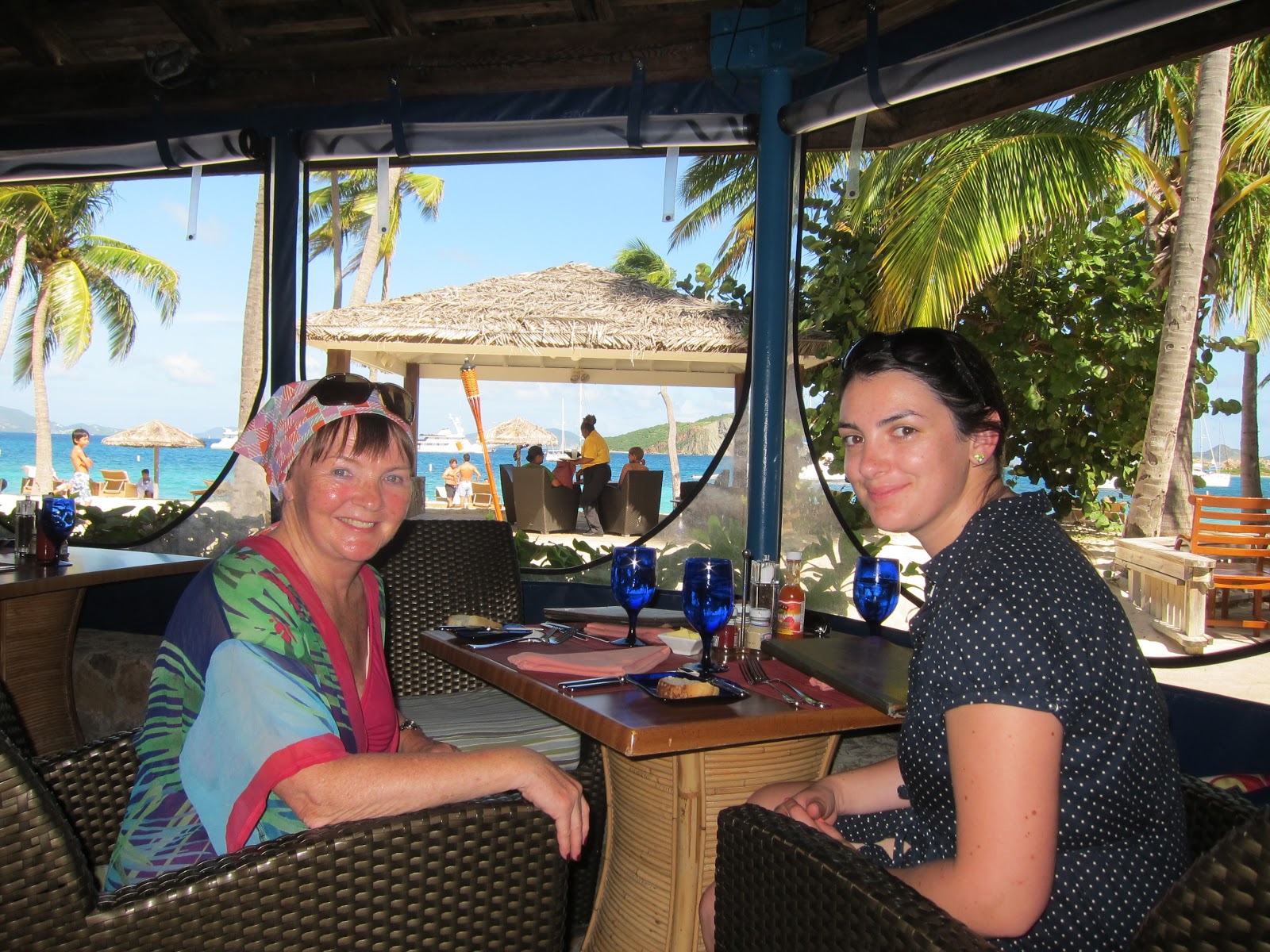 |
| Lynn and Estelle at a beach restaurant on Peter Island |
 |
| New Year's Eve on the beach at Trellis Bay, BVI |
Subscribe to:
Posts (Atom)