I know it is nearly 6 months since I made a blog entry about my travels. In recent weeks the e-mails from people asking where I am and am I all right and why are there no entries on my blog since May, have finally shamed me into action. Before you begin to read, however, I warn you that it will be rather tame by comparison with previous entries but if you bear with me to the end you will see that there are some interesting adventures coming up soon.
The Cottage
I left you all as I was leaving Easter Island for my summer cottage in Canada which is where I am now (and I’m just fine, thanks for asking). If you look at the pictures below you will see that this is not a “cottage” in the English sense---thatched roof, roses round the door. This is a Canadian style “cottage”---a summer place on a lake. The Americans call them “cabins” or “camps”. Lakes abound in many parts of Canada, but “cottage country” is at its most prolific in southern Ontario.
The Canadian Shield, a geological sweep of granite arching across Ontario and Quebec, from Hudson’s Bay to the St Lawrence River, was formed in the last Ice Age. The glaciers left in their wake indentations in the ice-compressed granite which over the millennia was covered with a thin layer of soil and the indentations filled with water, forming tens of thousands of lakes dotted with islands. The soil is too thin in most places to support more than hard-scrabble farming, but the sparking blue lakes teeming with fish, with their shorelines and islands of pine trees, granite boulders and cliffs, attracted holiday makers, initially in the later nineteenth century from the eastern US and now from the cities of Toronto, Ottawa and Montreal. Look in any glossy magazine with advertisements for tourism in Canada and you will see the photos of the red canoe on the dark blue lake, the light blue sky, the rugged granite outcrops, and the dark green pine trees. That is really and truly what it is like.
However my summer cottage is a little more elaborate than many cottages, since a couple of years ago I had to have the old cottage (built in 1893 but very sadly completely unsafe structurally) rebuilt as a fully functioning home, where I have moved all my books and souvenirs from my homes in the UK. It is built on a (very small!) island which affords me 360 degree views of the lake from the large expanses of windows on all sides. The lake itself is large and beautiful with 110 miles of shoreline and dozens of islands, many uninhabited, which I can explore with my two boats and two kayaks. The new cottage has “all mod cons” which permits me to stay here through cold weather, storms and blistering heat.
However, I do not intend to stay over the winter---the long windy freezing snow-bound winters are one of the reasons I left Canada in the first place. So after an idyllic few months during which I read a number of the books I have accumulated over the decades and never had a chance to read, sorted souvenirs, made up photo albums and swam, went boating and entertained friends and relatives who have come to visit me here at the cottage, I will be leaving in two weeks.
But this will not be my first departure this summer. As many of you know I went back to the UK for six weeks this summer (beginning of July to mid-August). This was for two reasons, my son Ken Okumura’s wedding and the Olympics in London.
The Wedding
Ken married Estelle Cousin in Edinburgh---most of you who have read any nineteenth century novels or watched series two of Downton Abbey on TV will know that Gretna Green, just over the Scottish border, was a favourite destination for eloping English lovers since Scotland does not have any residency requirement for those wishing to marry there. Since Ken and Estelle are currently resident in the British Virgin Islands, re-establishing residence in England or in Estelle’s native France would have been a protracted process.
Ken and Estelle have known each other for 10 years, having met as fellow fans and groupies of the band "Radiohead". Having despised each other for the first 5 years (he a "stuck up brat" and she "up to no good") they got together at Christmas 2009 and have lived together in the BVI since 2010.
Ken and Estelle have known each other for 10 years, having met as fellow fans and groupies of the band "Radiohead". Having despised each other for the first 5 years (he a "stuck up brat" and she "up to no good") they got together at Christmas 2009 and have lived together in the BVI since 2010.
They chose the Balmoral Hotel in Edinburgh for most of the wedding festivities. The Balmoral is a fine Edwardian hotel in central Edinburgh, run expertly as part of the Rocco Forte Group and holding a Michelin star (very important for my gourmet son). They had a "humanist" ceremony which they wrote themselves--charming and moving.
It was a small wedding (47 guests but from 14 countries) but was preceded and followed by a number of other celebrations in Edinburgh (family dinners, disco, karaoke, vintage bus tour), and elsewhere in the UK, and in France so there was plenty to keep me very busy over a number of weeks. Next summer we will reprise the celebrations here in Canada for the Canadian relatives and friends who were not at the wedding.
It was a small wedding (47 guests but from 14 countries) but was preceded and followed by a number of other celebrations in Edinburgh (family dinners, disco, karaoke, vintage bus tour), and elsewhere in the UK, and in France so there was plenty to keep me very busy over a number of weeks. Next summer we will reprise the celebrations here in Canada for the Canadian relatives and friends who were not at the wedding.
I am pleased to say everything went without a hitch and a good time was had by all. I’ve included a few pictures below and those of you who want to see more can look on my Facebook page for my albums of photos.
The Olympics
I also enjoyed the 2012 Olympics in London very much. I am definitely not a sports fan so that was not the appeal for me. But I am a huge fan of London and wanted to be part of such an important event for the city. And I was even prouder of London and indeed the whole of the UK for how triumphantly they succeeded with the event. There is no doubt that you cannot beat the UK for its ability to pull off spectacular public events with effortless aplomb.
Of course it is helped by having such a wealth of iconic sights as backdrops and centuries of experience of pomp and pageantry. It all looks so easy and natural but behind it is meticulous planning, unobtrusive but massive security, relentlessly drilled logistics, tasteful professionalism and thought to every detail.
Of course it is helped by having such a wealth of iconic sights as backdrops and centuries of experience of pomp and pageantry. It all looks so easy and natural but behind it is meticulous planning, unobtrusive but massive security, relentlessly drilled logistics, tasteful professionalism and thought to every detail.
The Olympics was not the only major piece of public theatre this year in London---it was also the Diamond Jubilee (60 years) of the Queen. (No need to say which “queen” you mean; everyone in the world knows who you refer to.) To successfully pull off two massive logistical events in one year (not to mention the Royal Wedding last year) takes a highly experienced hand, and Britain is nothing if not that.
The Olympics was a massive undertaking, with many elements that even a master of public events like London had not previously encountered. London is not a totalitarian state so it is not possible to ride roughshod over individual rights and private property interests. It is an ancient and geographically confined city, densely populated, with an overloaded infrastructure and no wide open hinterland on which to build stadiums. It is at the centre of many important world events and so is an irresistible target for crazies. It is a world economic hub and so business and enterprise cannot be shut down for two weeks while sporting events take place.
As some of you know I was a London Ambassador, one of the 70,000 volunteers who supported the Olympic events. Volunteers appeared as performers in the Opening and Closing Ceremonies, they acted as guides and cheerleaders at the Olympic events, and they were stationed around London to assist visitors find their way around the venues and the London sights. They have (rightly I would say) been regarded as one of the huge successes of the Olympics.
I was stationed at Marylebone Station. We had a very “bright” uniform ---all pinks and purples—which blinded you when you took it out of the box, but which proved to be a very good idea since you were instantly recognisable to visitors.
No amount of training can prepare you for the questions you will be asked or for how tired you get being on your feet and alert all day (particularly after the rather relaxed life I have been leading since I retired), but it was exhilarating work, being part of such a momentous event and I am very glad I did it.
The Olympic organising committee had wisely used the instantly recognisable sites of London to great effect. The equestrian events were held at Greenwich Park with, as backdrop, the Royal Greenwich Observatory (Greenwich Mean Time and the place from which all longitude is measured) and the 500 year old buildings which were the centre of naval life when “Britannia Ruled the Waves”. The marathons passed Buckingham Palace and the Houses of Parliament. The cycle races went through beautiful English countryside and the Royal Parks. The rowing and canoeing were held in the waters on which Eton school boys have rowed for centuries and near the Queen’s home at Windsor Castle and close to Runnymede where the Magna Carta was signed by King John marking the birth of democracy. The sailing was held at the ancient harbour of Weymouth dating for 1200 and from which colonists sailed to the New World and established several new “Weymouths” in the US and Canada. Even the greatly unloved Millennium Dome, that white elephant testament to Tony Blair’s hubris, which has recently been successfully rescued as the O2 Centre for pop concerts, was turned into the venue for the gymnastics.
No doubt in my mind, and in most people’s, however, will remain the image of the Olympic Park. Built in the heart of the most run-down part of east London (London won the 2012 Olympics in part on the promise to regenerate the area, which I believe it has admirably succeeded in doing), it was the centrepiece for the most popular events such as athletics and swimming and cycling . The site showcased dramatic new structures including the Olympic Stadium itself, built substantially of recycled materials.
Most of you will have seen pictures of the Olympic Park on TV and in the newspapers, but what these images cannot convey is the thought and creativity which went into making the Park a pleasure to walk through. Instead of acres of concrete and steel and glass, there were banks of beautiful wild flowers, trees, banks of grass to sit on, a riverside walk to stroll along, easy-on-the-feet pavement (I don’t know what it was but it seemed cushioned).
No neon, no billboards, no harassing hawkers, and most importantly no problem getting by public transport to the site or getting in. Friendly and enthusiastic volunteers to show the way and answer questions. The handsome young soldiers who manned the airport style security at the entrances and charmed all comers. Minimal queues; all very smooth .
No neon, no billboards, no harassing hawkers, and most importantly no problem getting by public transport to the site or getting in. Friendly and enthusiastic volunteers to show the way and answer questions. The handsome young soldiers who manned the airport style security at the entrances and charmed all comers. Minimal queues; all very smooth .
The BBC redeemed itself after its embarrassing and inexcusable coverage of the Queen’s Jubilee and provided full coverage of every sport and every event via the “red button” and laid on thoughtful and knowledgeable commentators. I understand that the coverage by the overseas television media was not nearly as good which is a shame.
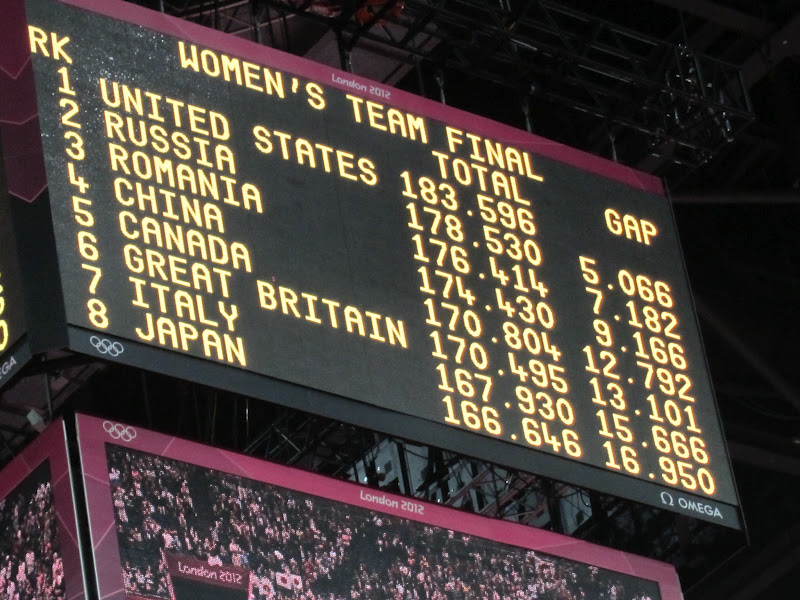
And yes I did get to a few events in person. I had an excellent seat for the women’s team gymnastic final. I attended a rehearsal for the Opening Ceremony and had a very expensive ticket for the Closing Ceremony. As has been said in the press and by the athletes, the best thing about the 2012 Olympics were the spectators: enthusiastic, attentive, knowledgeable, generous in their support for all athletes no matter what their nationality. It must have been a true pleasure to perform in front of such crowds. And the army of volunteers, which received universal praise JJ.
The Olympic Effect has done a lot to restore the self-esteem of a recession-battered Britain and to put the Great back into Great Britain.
What’s next???
So I am leaving my Canadian idyll in less than two weeks. Where to?
I will fly to the British Virgin Islands for two weeks to visit Ken and Estelle and help them pack up their things. They are moving back to London (a very good thing in my view---a place like the BVI that features in the honeymoon travel brochures with florid labels like “tropical paradise” is not the place to live a real life).
Then I will return to London to take care of some personal affairs and assist Ken and Estelle to settle back into their apartment. Before Christmas I am planning a couple of weeks in Morocco which currently seems to be the only African or Middle Eastern country which may not blow up in my face. I hope to see Fez and the Atlas Mountains and the Sahara and of course Marrakech. After returning to the UK, if there is time, I may do a long weekend at one of the Christmas Markets in Germany.
Right after New Year I will head off to Australia where I haven’t been for nearly 40 years. I will spend a bit of time seeing Tasmania before boarding a ship to Antarctica for nearly three weeks. As many of you know I went to Antarctica in 2008 and to the Arctic in 2009. I was really smitten by Antarctica and this time I will be visiting from “the other side”: from the east (Australasia) rather than from the west (Argentina where I went from in 2008).
The ship returns to New Zealand in mid-February and I will spend a few weeks travelling there before returning to Australia (the Kimberley Coast on the top left hand side of Australia appeals to me and I have never been to western Australia either) . I will also try to get to Papua and New Guinea and maybe elsewhere in parts of South East Asia that I haven’t been to.
I will return here to my cottage in Canada at the end of April. I am toying with a doing a trip through the Canadian North West Passage in late summer and then in the autumn I will resume my South and Central America travels. By the end of 2013 I will take stock and see whether I still have the desire—and more pertinently the money ---for more travels.
Below are some photos of various events and places since my last post from Easter Island. I will be travelling in Ontario over the next week or so and hope to add some photos of the famous autumn colours as the leaves turn gold and red.
Now that I am getting on the move again, keep checking back periodically on this blog.
 |
| Estelle, Ken and Lynn at the reception after the wedding ceremony |
 |
| Ken and Estelle siging the register--Ken made Estelle's bouquet of origami cranes for good fortune |
 |
| The bride and groom |
 |
| The wedding guests |
 |
| Lynn at a loch-side picnic in Holyrood Park on the Vintage Bus Tour on Bastille Day following the wedding |
 |
| Ken and Estelle outside Amberley Castle in Sussex where one of the post-wedding celebrations was held |
 |
| My summer cottage on Goose Island, Charleston Lake, Ontario |
 |
| A view from the library of my cottage |
 |
| Another lake view from a window of the cottage |
 |
| Hector, one of the herons who frequent my island |
 |
| A Charleston lake sunset seen from my island |
 |
| The start of the autumn leaf-colour---I hope to upload a few more as the fall colours progress |
 |
| Part of the library of my cottage |
 |
| A view from my bedroom |
 |
| Part of my living room |
 |
| NO THESE ARE NOT CUTE!!! Canada Geese are a plague that has afflicted me all summer on the island. They each eat 2 pounds of grass a day and it all comes out the other end onto my lawn. |
 |
| A spring visitor--- turtles are common around the lake and come ashore in spring to lay their eggs |
 |
| Autumn bounty in the local farm shop |
 | ||||||||
My new car--a Toyota RAV 4
   Lynn on duty as a London Ambassador at Marylebone station during the Olympics    The laser light show at the Closing Ceremony 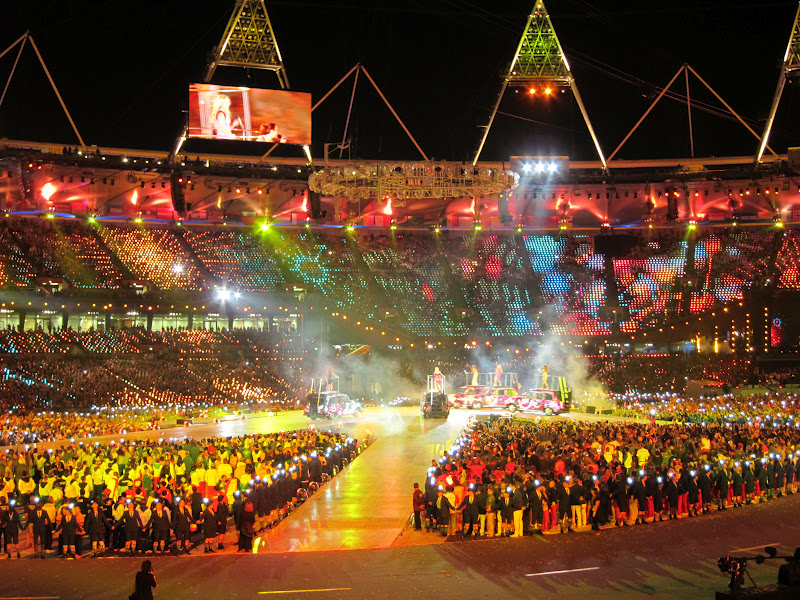
The Athletes assembled at the Closing Ceremony
 |


