Friday, 23 March 2012

North Western Argentina, Part 2

I hope my post a couple of days ago gave you a flavour of the beauty of the landscape in north western Argentina. Here are a few more observations, particularly on the people--both the tourists and the locals. There are also some more photos at the end.


Indigenous people--then

The area of north western Argentina has been occupied for thousands of years by indigenous tribes who spread down from Peru and Bolivia. However they were pre-literate and so there are no written records. It seems that they were hunter gatherers for about 10,000 years until about 700 AD. Then they gradually turned to agriculture which they carried on in the wide fertile river valleys. As the population increased as a result of this healthier and safer life-style, the different tribes, sub-tribes and clans came into contact with each other and clashes occured. This led to the creation of defensive settlements, perched on hills overlooking the valley where attackers could be readily seen and resisted. 

The Quilmes

The fantastic ruins at Quilmes are an example of a superb defensive position from which the Quilmes tribe, who communally, successfully resisted, first the predations of other tribes, then the advances of the Inca civilisation from Peru in the mid-1400s, and lastly the Spanish conquistadors, until the mid-1600s. The site could not have been better if it had been purpose-built and the Quilmes took full advantage of its natural benefits. 

They were finally defeated and the whole tribe of 2000 souls was made to walk through the desert to Buenos Aires a distance of 1500 kilometres. Theories vary as to whether any of them survived but the legend certainly lived on, not least in a famous brand of Argentinian beer, Quilmes. Eventually the ruins of the original settlement were returned to those who purport to be the descendants and they have opened the site to low-key and very atmospheric tourism. 


The Inca period

The Inca left their mark too, although their time of power in Argentina was quite brief--not even 150 years. Like the Romans they were master engineers and builders and built roads and irrigations systems as well as co-opting rather than waging war against the local tribes. 

Salta has a world-class museum (MAAM) illustrating the weaving and craftsmanship of the Incas and their custom of sacrificing chilren to the gods of the volcanoes. Northwestern Argentina does not have many volcanoes, its geology being overwhelmingly sedementary rock. However on the Chilean border is the 6700 volcano of Llullaillaco. At the top of this volcano was found in 1999 the perfectly mummified bodies of three children, surrounded by all their grave goods. The children were not touched, just given a powerful sedative and their bodies were preserved perfectly by the cold and lack of oxygen and humidity on the mountain. 

Each of these mummies are displayed in rotation for a few months in the latest atmosphere-controlled conditions in the MAAM museum--the one I saw was the 6 year old girl. The display is extremely well done and not at all goulish  (hence no photos in the museum). These children were selected from the highest born families and were the most perfect and beautiful specimens who were chosen to make the journey to the afterlife with the god of the volcano.


The Jesuits

The Jesuits left their mark in the region as well. Each of the little pueblos/villages has a small adobe church with cactus wood ceiling and mud covered roof. I have included some photos. Most of the churches do not permit photography inside.  Without doubt the most beautiful one was the little church in Uquia in the Quebrada de Humahuaca, built in 1691. It has a gold altar of finest craftsmanship which takes up the whole of one end of the church, and the walls are lined with first quality religious  paintings by native artists who were taught to paint in oils in the European style by the Jesuits---known as the Cusco School of painting.

 I saw a lot of these paintings when I was in Cusco, Peru, and the ones in Uquia are the match of any of those. All of the Cusco school painters seem to have had slightly subversive streak---they unobtrusively inserted elements of their own religious iconography into their Christian religious paintings or they would include slightly bizarre features which could not really be faulted but which were clearly tongue in cheek. For example the " Last Supper" in the Cusco Cathedral is a traditional European painting in every way except that the food on the table is a roast guinea pig, which was the feast dish of the Inca. 

In Uquia the paintings are of the Archangels (Raphael, Michael, Gabriel etc) who guard the gates of heaven, executed in exquisite detail in the European style but each one of then is carrying a 16th century  gun (also painted in exquisite detail) , with which the conquistadors had subjugated the local peoples. 


The Encomanderos

Another aspect of the Spanish rule which I hadn't been aware of was the "encomandero" system. As the Spanish extended their conquests further and further south they awarded vast tracts of land to privileged conquistadors, ostensibly to ensure that the local people were converted and followed the Roman Catholic religion. However these encomanderos  became the local aristocrats and land owners with total control over the local people who worked on the encomandero's fiefdom in virtual slavery. 

They got their come-uppance at the time of the wars of independence from Spain in the 19th century. Because they tended to be highly conservative and loyal to the Spanish crown from whom they derived their power, they resisted the independence movement and so had all their lands confiscated by the new republic. As a result the origins and layout of today's towns and villages is different dependingon whether they were originally founded around an encomandero's estate or whether they were a traditional native pueblo. 


Today 

As soon as you step off the plane you can see that, unlike in the central and eastern parts of Argentina,  the people of the northwestern Argentina are, unsurprisingly,  predominantly of  indigenous extraction. However, as in other parts of Argentina there is a class divide and those who look more European tend to be the more prosperous and powerful. 

Tourism is clearly a major source of income but there is also excellent agriculture and some light industry in the valley between Jujuy and Salta. I mentioned in my previous post the fertility of the soil. If the land happens to be on the eastern slopes of a mountain chain where the prevailing winds drop their rain or in the river valleys which can be watered and irrigated, a vertible cornucopia of fruits and vegetables flourish as well as cash crops such as soy beans, maize, tobacco and even sugar cane.

What I haven't mentioned before are the handicrafts. I am not a big souvenir buyer and am always looking for the "Made in China" label on things. And indeed there is a great deal of tat being sold in stalls in the village plazas and passed off as hand made crafts. 

However there is some really good stuff. As we drove down the winding gravel road from Cachi to Los Molinos south of Salta my guide turned off onto an even worse rutted stony road called the Road of the Artisans. There in the middle of nowhere are the workshops of the native weavers of Argentina. When I say "workshop" I mean a loom set up outdoors, beside  their little adobe compound, with the spinning an dying of the sheep and llama wool done next to it and the beautiful finely-woven ponchos and shawls and and decorative items hung on lines between the trees. They do not weave for the commercial market but only what they sell from their compound on the Road of the Artisans. 

Weaving is by tradition a man's job, with the skill passed from father to son,  and the women do the spinning and dying. The loom is operated standing up, completely manually by hand and foot and the dyes are all natural from berries and nuts. A full sized poncho takes  3  to 4 months to weave.

We stopped at the workshop of Arnaldo Guzman. His father was selected by the Argentinian government to make a poncho of vicuna wool for the Pope on the occasion of his visit to Argentina. And it is clear that Arnaldo has his father's gift.  And he and his wife were utterly charming. Yes I did buy a few things :) 


The tourists

What I found rather interesting though was the ethnic profile of the tourists! There are almost no tourists from the UK, but there are a great many French tourists! My guide told me that the main European tourists to the region are French, followed by Belgians, and then the Spanish and the Germans!  I did run into a fair number of Canadians and there are a number of Americans as well.  Cafayate is a very cosmopolitan and happening little community and a big complex is going up in the suburns of retirement villas for Americans complete with golf courses and vineyards where you can try your hand at growing vines.But of the Brits, not a sign. 

I guess it all comes down to marketing. I had a casual browse through the websites of the major British tour companies just now and although they feature Buenos Aires and Iguazu Falls etc,  the Salta region is hardly mentioned except as a place to go trekking in the mountains. This is a real shame since the  tourist infrastructure of the region is not bad at all and English speaking guides are readily available. And the scenery and history is beguiling. There is no need to "rough" it. If I was looking for a new career (I'm not)  I would wake up the UK market to the tourist opportunities of north western Argentina.


They make an excellent white wine, "Torrontes" around Cafayate (see blog). This is me at a wine-tasting in the Porvenir  winery.


Ditto--note traditional adobe walls and traditional barrels

There are excellent native weavers in north western Argentina. These are some of the wares of Arnaldo Guzman. See blog

Arnaldo at his loom. See blog

Arnaldo's wife with one of the lovely grey-green parrots of the area

This a view over the ruins of Quilmes south of Cafayate (see blog)
The pucara ruins at Tilcara in the Humahuaca gorge--one of the earliest archaelogical digs in the 1930s

Quilmes again


The North West if full of charming small churches, most built during the time of influence of the Jesuits in the 1600s

Because there were very few trees at the time , cactus wood was used a lot in these churches for the ceilings and altars etc. Here is a confessional in cactus wood. Not the "woodpecker" effect. See blog part 1

Another of the rural churches, this one in Purmamarca. The tree on the right is supposed to be 700 years old.

This church is in the tiny pueblo of Uquia , but it has a marvellous golden altar -piece  and very very fine Cusco School paintings (see blog). Unfortunately no pictures allowed.

The land beside the rivers is very fertile when irrigated and all manner of vegetables are grown for sale fresh or dried, as here.

The ovens at the Sala de Payogasta, which serves excellent lunches in the middle of no-where. I had roast goat and roast  freshly picked vegetables.

I took a walk into a field near the river at Payogasta and the farmer presented me with these two beautiful pimento specimens

There are some excellent B&B accomodations in the Salta area. This is the breakfast room at Bloomers in Salta

--And this is the outside of Villa Vicuna in Cafayate

And the inner courtyard of the B&B "Villa Vicuna" in Cafayate


Poor picture but these are the "labcoats" that the public school children wear over their clothes to keep off the dust  from the desert and the gravel roads. The private school children wear uniforms such as you would see in any country---pleated tartan skirt or grey flannels and v-neck jumper etc. 

A central market in Humahuaca--every small town has one

ditto

ditto

a typical cobbled street lined with single story houses, which you would find in any pueblo in the area. This one is in Humahuaca. Despite their humble exterior these no doubt inside all these have a cool shady courtyard with the rooms facing onto the courtyard. 

New and old---note the traditional adobe walls, with satellite dish


The cathedral in Salta --only mid-1800s so not as old as the little churches pictured above.


Fine gold altar in the cathedral

an old street in Salta

The Cabildo (town hall) of Salta  at dusk. This is the oldest in Argentina--all the others have been mangled or bulldozed.

The highly theatrical San Francisco church in Salta--it is deep red and gold.
--and by day. Note the stone "drapery" over the lower archways. Built 1796.


Lunch in the courtyard of the Hosteria Los Molinos, under the shade of the ancient pink peppercorn tree.


Tuesday, 20 March 2012

North Western Argentina, Part 1


I have spent the past 6 days in the northwestern provinces of Argentina--Salta, Tucaman,  and Jujuy (pronounced Hoohooee). I decided to take a private tour rather than drive myself and I am sure glad I did! We covered 1400 km, with some long stretches over gravel roads and plenty of switch-back roads climbing up and down mountains. Even if I could have driven it safely I would not have seen a thing, since I'd never have been able to lift my eyes from the road. My guide, Joaquin, was a superb driver, completely fluent in idiomatic American English (although he has never been outside of northern Argentina), and full of information about the land, the geology, the culture, the flora and fauna and the people, which he imparted while cruising effortlessly round hairpin bends.


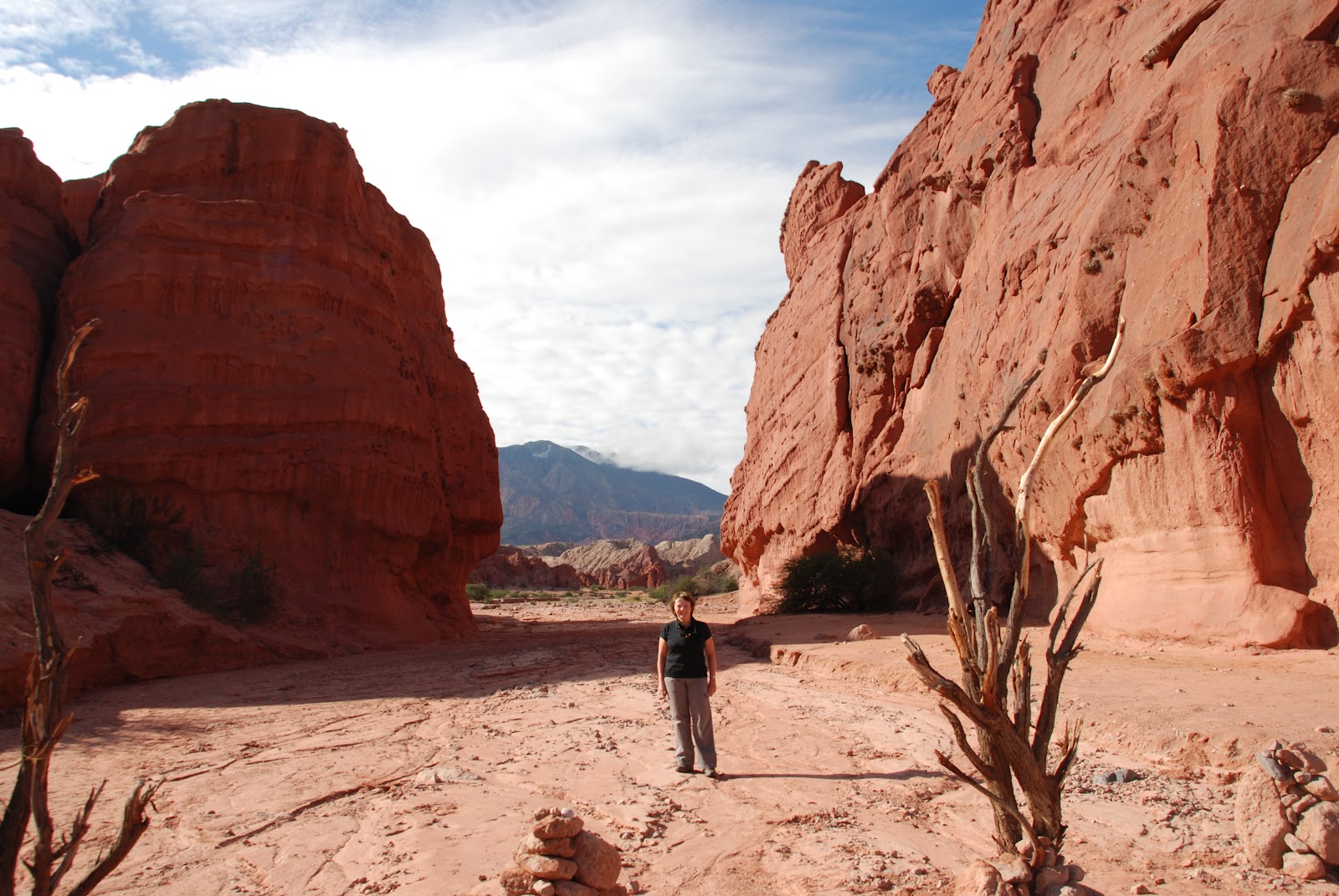
The contrasts between what I have seen in the north west and what I saw in the Cordoba area and in Buenos Aires are vivid--the people, the scenery, the terrain, the history, the colours. It is natural to want to relate new things one sees to places one knows, and the closest I can come up with is that the northwestern provinces of Argentina remind me of New Mexico and Arizona in the southwestern USA--the desert scrub, the deep rich pinks and reds of the rock, the native pueblos, the strange shapes of the rocks, the mountains, the gorges and canyons. However, although there are no jawdropping slits in the earth like the Grand Canyon, I  think the colours and variety in the scenery are greater in Argentina . 


Within a radius of about 200 kilometres from Salta, the main city, you can drink wine at a sophisticated vinyard in Cafayate, visit eery salt flats at Salinas Grandes on the way to the Andes and the Chilean border, drive up a mountain pass to 4700 meters with views to die for, view wierd shaped rocks formed by tectonic plate shifts and erosion, explore the ruins of native strongholds from Inca times at Quilmes and Pucara,  visit charming little rural churches built  of adobe in the 1700s and housing stunning rococo gold alters and fine paintings of the Cusco School (the Jesuits taught the Incas to paint in the European style and they were superb artists), drive through sub-tropical rainforest with moss and vines and orchids and then half an hour later through a desert of cactuses.


Take the cactus for example. The area is full of many -armed giants which you would immediately identify as suquaros, like those found in the  the southwestern US and seen in many cowboy movies.  But they are not. The Argentinian ones  are cardones, and they are not even cousins of the suqauro. They have a wooden inner skeleton with holes in it as though a woodpecker had been at it. This is strong wood and all the pretty little seventeenth century churches have cactus wood ceilings and many have confessionals and altars of the wood as well. At the time it was the only wood available since there were no other trees of any size or substance except the hardy but scraggy acacia. Now there are a number of non-native species which have been introduced and which thrive, particularly in areas where man has introduced irrigation. Tall thin poplar trees or even cyprus are a sure sign of human habitation well before you see the little pale pink adobe house camouflaged against the pale pink rocks and soil and shaded by these foreign imports. In the river valleys shady willow trees and even oak trees flourish.


They say the dessert blooms when it receives water and that is certainly true in north western Argentina. The river valleys, areas which are irrigated, and the slopes beside mountain springs are filled with wonderful crops of carrots, pimentoes, cabbages, corn, lettuce, tomatoes, as well as cash crops like tobacco and soy beans and even sugar cane. 


And that word "seventeenth century" in the previous paragraphs points to another difference between what you see in Argentina and what you would see in the southwestern US. North west Argentina has a longer and even more painful history than the southwestern USA, subject to continuous invasions from Peru and Bolivia during the Inca expansion and conquests of the 15th and early 16th century followed by the far more brutal and devastating scorched earth policies of the Spanish conquistadors and the somewhat more benign but no less disruptive expansion of the Jesuit missions, and finally it was a key battleground in the early nineteenth century when the south american colonies of Spain were fighting for their independence. The ruins of the native villages sit forlorn, many hardly excavated at all. But beside them are the new native villages of low adobe houses huddled together on narrow cobbled and dusty streets. And there are even modern ruins--the little railroad towns that were built in the nineteenth century and early twentieth century when Argentina was rich and expansionist, have been abandoned since the Argentinian government abandoned its railway system in the 1980s.


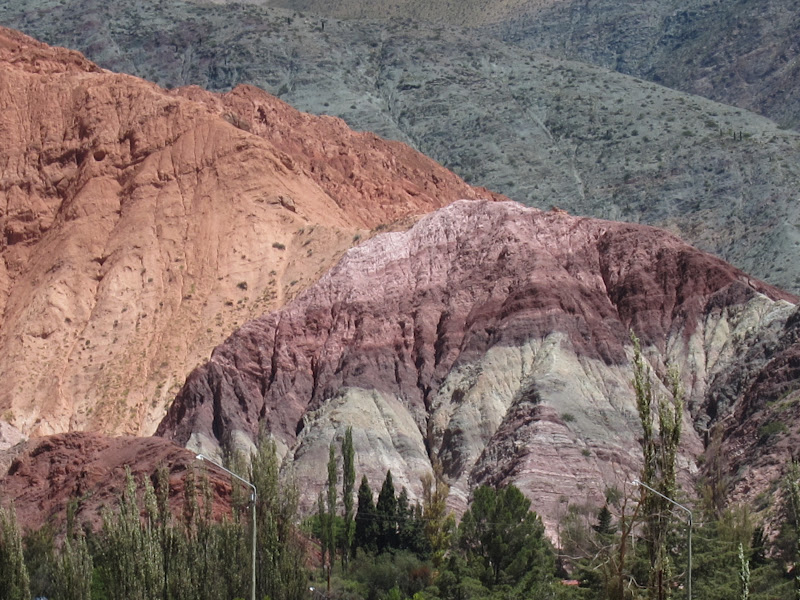
But the colours are what you really cannot believe. And you try again and again to capture them on film but they never look as good. Incongruously,  the image that kept coming to my mind was Missoni designs, which I am very fond of. For those of you not familiar with the name, the Missoni family are Italian designers of beautiful and distinctive knitwear and fabrics with colourful zigzag patterns . That is what the colours and patterns of the mountains look like. Here is a link so you can see what I mean. 
http://www.google.com.ar/search?q=missoni&hl=es-419&rls=com.microsoft:en-GB:%7Breferrer:source%3F%7D&rlz=1I7TSCA&prmd=imvns&tbm=isch&tbo=u&source=univ&sa=X&ei=H4poT5z9LYKutweZ99X8CA&ved=0CIwBELAE&biw=979&bih=422 


How are these colours created? If you are a geologist and find the following explanation laughable, bear with me; I am inspired now to take a geology course so that I can really understand what I have seen. Northwestern Argentina was formed not by volcanic action but by tectonic plate shifts of its sedementary rock base. Thus you see mountains heaved up to show the strata vertically. You see fingers of erosion dribbling down the cliff faces looking like those sandcastles and mudpies you used to make as a child. The rock is very rich in iron, copper, lime and sulphates, which at various stages of oxidation yield brick reds, purples, pinks, forest greens, moss greens, spring greens, golds, yellows, creams, whites, with crytals adding a sparkle here and there.


And there are huge snow capped mountains--over 6000 metres. And salt flats shimmering like a mirage as far as the eye can see. And alpaca and llama and I even got a photo of the elusive and fleet of foot vicuna. 


Yes, pictures. I took hundreds. I've included a selection here and will do some more in a few days (photo uploading is slow work). (Unfortunately my big Nikon is on strike and many of my photos do not do justice to the colours although my Canon S90 has filled the gap quite admirably.)


I also have more to say, particularly about the people and the towns and pueblos but will get this posted now and do another post with more pictures and the rest of the story, in a couple of days.


This is the view that greeted me on my first morning out of Salta. This is the hotel Payogasta and the snow covered mountains are over 6000 meters high.


another view from the hotel at Payogasta. In the foreground are fields of pimentos, then the Calchaqui River,then the sand and gravel cliffs, then the green scrub-covered mountains and then the snow capped big boys.


View along the way to Cachi 


The road winding through the mountains in the Quebrada (gorge) de Escoipe. Reaching to 3700 meters

and again


The viewpoint at the top of the road out of the Quebrada de Escoipe


Los Cardones National Park 

Los Cardones National Park--the cardones are the cactuses. There is an arrow-straight Inca road that runs through the middle.

ditto

Arrow Gorge


view from the road leading from Cafayate back to Salta

One of the many spectacular coloured sights on the road from Cafayate

And again


Strange rock shapes in silhouette


Llama grazing

Needless to say the goats are quite at home on these mountains. And roast goat is delicious.


Organ pipe-like cliffs
a small village in the Quebrada de Humahuaca

Quebrada de Humahuaca

The Seven Coloured Hill behind the pueblo of Purmamarca

A closer look


some of the subtler greens of the copper oxide in the hills

This one is nick-named the elephant's foot, and it must be a female elephant because of the painted toe-nails

This is called the Painter's Palette, for obvious reasons. In the foreground are the mausoleums of the cemetery of the pueblo Tilcaara

Ditto

The quebrada (gorge) of Humahuaca


the greens of the copper oxide in the mountain in the foreground, with the pinks of the iron oxide in the further range of mountains


The road up from the Quebrada de Humahuaca over the Cuesta de Lipan pass to Salinas Grandes and then on across the Andes to Chile

The highest point by road on the Cuesta de Lipan pass--4170 metres

Mountain view in the Cuesta de Lipan pass
The road up from the valley of the Quebrada de Humahuaca,. Believe it or not this is  road is a major trucking route from Argentina through Chile to the Pacific port of Antofogasta. You see articulated lorries/tractor trailers crawling up and down this switchback road carrying all manner of goods. It is a tough enough drive in a car but in a heavily laden tractor trailer it must be a nightmare. We saw one overturned lorry which hadn't quite judged a hairpin bend right, and apparently this is a regular occurence.


The salt flats of Salinas Grandes, over 200 square kilometers at 3500 metres above sea level. After the rainy season there was an inch or two of water on the surface, which created mirage-like reflections of the sky.

ditto

ditto

The salt is raked into channels and pyramids to be harvested.


The main highway crosses the salt flats. The walls of this  service building is made entirely of blocks of solid salt


The tropical rainforest on the cornice road from Salta to Jujuy. Note the orchids growing on the tree trunk and branches

ditto

I'm pleased with this picture. This is the elusive, rare, and fleet-of-foot vicuna. Yes, it was taken with a zoom but even so for such a notoriously solitary and shy creature he allowed me to get remarkably close.