The ship is currently threading its way through the pack ice
as we try to find a path through into the Ross Sea so that we can land and
visit Scott’s and Shackleton’s huts from their pioneering expeditions to the
South Pole a century ago. Surprisingly we seem to still have internet access
although not strong enough to upload many pictures. So I will load up the
narrative now and the photos, as well as more of my Tasmania photos, when I get
to New Zealand in two weeks’ time.
Macquarie Island
The ocean distances are vast, populated by wheeling
sea-birds of many different species, small and large—there are 80 different
species of petrels and albatrosses alone. Because the southern hemisphere has
much less land than the northern hemisphere these birds are expert at coasting
on the winds with their gigantic wings and they can stay at sea for years, only
coming in to land (clumsily!) to breed.
Our first landing after three days at sea out of Hobart, was
at the sub-Antarctic Island of Macquarie which is Australian territory and has
an Australian research and weather station on it which is home to about 30
people who are there for 6 months to two years. It is now also a World Heritage
site and Australian national reserve.
The sub-Antarctic islands are interesting since they are
outside of the Polar Front, which is where the cold Antarctic currents meet the warmer ocean currents. The result is that they are snow free and quite green with
a steady average temperature range between plus 1.6 degrees and 6.6 degrees and
an abundant rainfall of 930 metres per year. However, at the same time the
sub-Antarctic islands are home to an abundance of Antarctic wildlife which has
chosen the warmer and ice-free land of the sub-Antarctic islands for breeding
and moulting.
Macquarie Island has an interesting geology since, at less
than 700,000 years old, it is very young (in geological terms) and is one of
the very few places in the world where the tectonic plates have pushed up the deep mantle from the earth's core to the surface above sea level. So you can see the internal magma which has been
extruded like toothpaste from a tube between the tectonic plates and which hardened
and then uplifted to the surface. Since the island is so young, it has not been
subject to volcanic or glacial action or erosion.
Macquarie also has coastal
terraces of supersaturated sphagnum moss and kelp forming peat five metres deep.
The surface is hilly and rocky and covered in green moss and low vegetation and
there are streams and fresh water lakes. Because of the high rainfall and
almost constant cloud cover and mist, the island has a strong likeness to
Scotland.
However Macquarie has been subject to much destructive action
by man. Because of its relative closeness to Australia and New Zealand it was
an easy target for whalers and fur-sealers. When the whales and fur seals had
been so reduced in numbers as to be uneconomical to hunt, the hunters turned
their sights on the population of sea elephants which haul out on Macquarie to
moult.
They are huge fat torpedo-shaped creatures, weighing up to 3000 kilos,
with large stores of blubber which enable them to spend months in the deep cold
waters near the Antarctic continent, diving up to 2000 metres for food. When those
reached dangerously low levels the hunters turned their attention to the seemingly
endless colonies of penguins which breed on the island. The penguins were
boiled (some say alive) in huge “digesters” for one pint of oil, to oil horse
harnesses!
In the process of exploiting the resources of Macquarie
Island, the hunters introduced many foreign plants and animals—rats off the
ships, rabbits (for food) and cats (presumably ships’ cats introduced to keep
the rats in line but which quickly became feral), as well as ponies, donkeys,
sheep.
By the time Australia belatedly awoke to the value of preserving the
indigenous creatures and plants, the rabbits had eaten all the endemic
vegetation and undermined to thin soil on the hills with their burrows, the
rats and the cats had eaten thousands of sea bird eggs and chicks, and the
seals and penguins had been decimated by the hunters.
Over the course of the
last fifteen years Australia has undertaken an extermination programme of
hunting and poisoning the rabbits and rats ---I haven’t had the courage to ask
how they eliminated the cats but they have gone too. It seems that now all
these invasive animals have been killed and as a result the endemic vegetation
including ferns, giant Macquarie “cabbage” (high in vitamin C and so sought
after by sailors) and what are called “mega herbs” with large grey green spikes,
are now recovering, in fact flourishing. The staff on the ship were commenting
on how different the island already looks after only one rabbit-free season.
The elephant seals and penguins on the island also are recovering well,
although fur seals and whales in the surrounding ocean are still at dangerously low levels.
There
are four kinds of penguins on the island: the King (which looks like a smaller
version of the Emperor penguin which you will have seen in documentaries and
films—very handsome with a sleek long neck, black back and white front and
orange markings on the neck and head and bill and weighing about 15 kilos), the
Gentoo (which we saw also on the trip I did in 2008 to the Antarctic Peninsula—the
ones on Macquarie have orange not red bills and weigh about 5 to 8 kilos), the
Rockhopper (a small, crested penguin weighing about 2 to 3 kilos, which true to its name hops, rather than
waddles like the other penguins and lives high on the rocky slopes of the
island) and the Royal which is found only on Macquarie, all 1.7 million of them.
The Royal is also a crested penguin weighing about the same
as the Gentoo, with long yellow and orange whiskers on the top of their heads.
The Royals are found in ancient rookeries near the coast but elevated about 100
metres above sea level.
Interestingly, the theory is that when Royal penguins
first started to use Macquarie for breeding and raising their chicks the
rookery was actually at sea level. Penguins are an ancient creature and were
around before Macquarie (which as mentioned earlier is a very “young” island extruded
from the oceanic crust) had reached its current elevation above the ocean.
The
King penguins incubate their eggs and chicks on their feet under a fold of
belly skin, like their larger more southerly cousins the Emperors. However they
have an unusual breeding cycle—they breed twice in every three years, so the
rookeries on Macquarie contain year old chicks in their “Russian overcoats” of brown
fluffy down , new eggs, and small chicks still nestling on their parent’s feet.
The day we arrived foul weather frustrated our attempts to
land. But we remained in the lea of the island until the next day and then were
able to do two landings, one at the base itself. Our ship, the Orion, seems to
have a deal with the Australian government that the ship will transport the
scientists to and from Macquarie in return for access to the base for its
passengers, so we had an interesting tour of the base and of the isthmus it
sits on, as well as scones baked especially for us in the base kitchen.
In the
afternoon we landed at Sandy Bay (black sand), further down the island where
there are huge rookeries of King and Royal penguins where we saw chicks,
moulting adults, grooming each other and
mating, all in a smelly, squawking mass of penguin-hood. And then as we sailed
away from the island in the evening we skirted Lusitania Bay which is home to over
a million King penguins, so many in fact that it is impossible to land since
the beach is blanketed with penguins for several kilometres. Ironically, in the
middle of this sea of penguins in Lusitania Bay there are three of the “digesters”,
rusting away: Penguins 10, humans 0.
Antarctica is like nowhere else on earth for seeing wildlife
since none of the birds or seals or penguins have any land-based predators
(except man!). That is in contrast to the Arctic where you see much less of the
wildlife because of their (justified) fear of the polar bears which are an
alpha predator.
And so you can walk slowly and quietly amongst the penguins and
if you sit down they will come up to you out of curiosity to inspect you in
your unusual plumage of red parka, and peck at your boots or your camera lens. Even the skuas, the huge brown birds which are
the hunters and carrion eaters of the Antarctic, seem to have no fear of humans
and apparently if they decide you are fair game they will zero in on your
camera lens which they think is a tasty eye.
Similarly the elephant seals,
which lay in great heaps on the beaches and in the tussock grass, will ignore
you—although if you get too close they can move remarkably fast and can give a
nasty bite apparently. It is not for the
fastidious though. Penguin colonies are smelly places and it is all too easy to
slip on the large ribbons of kelp and land in a puddle of ____.
And so now we are on our way to the main continent of
Antarctica and into the Ross Sea. We have been at sea for four days since
leaving Macquarie and I think we have another day or two before we reach a
landing. We are now well and truly into the Antarctic region –check back in a
few days for more updates and (eventually) for photos.
 |
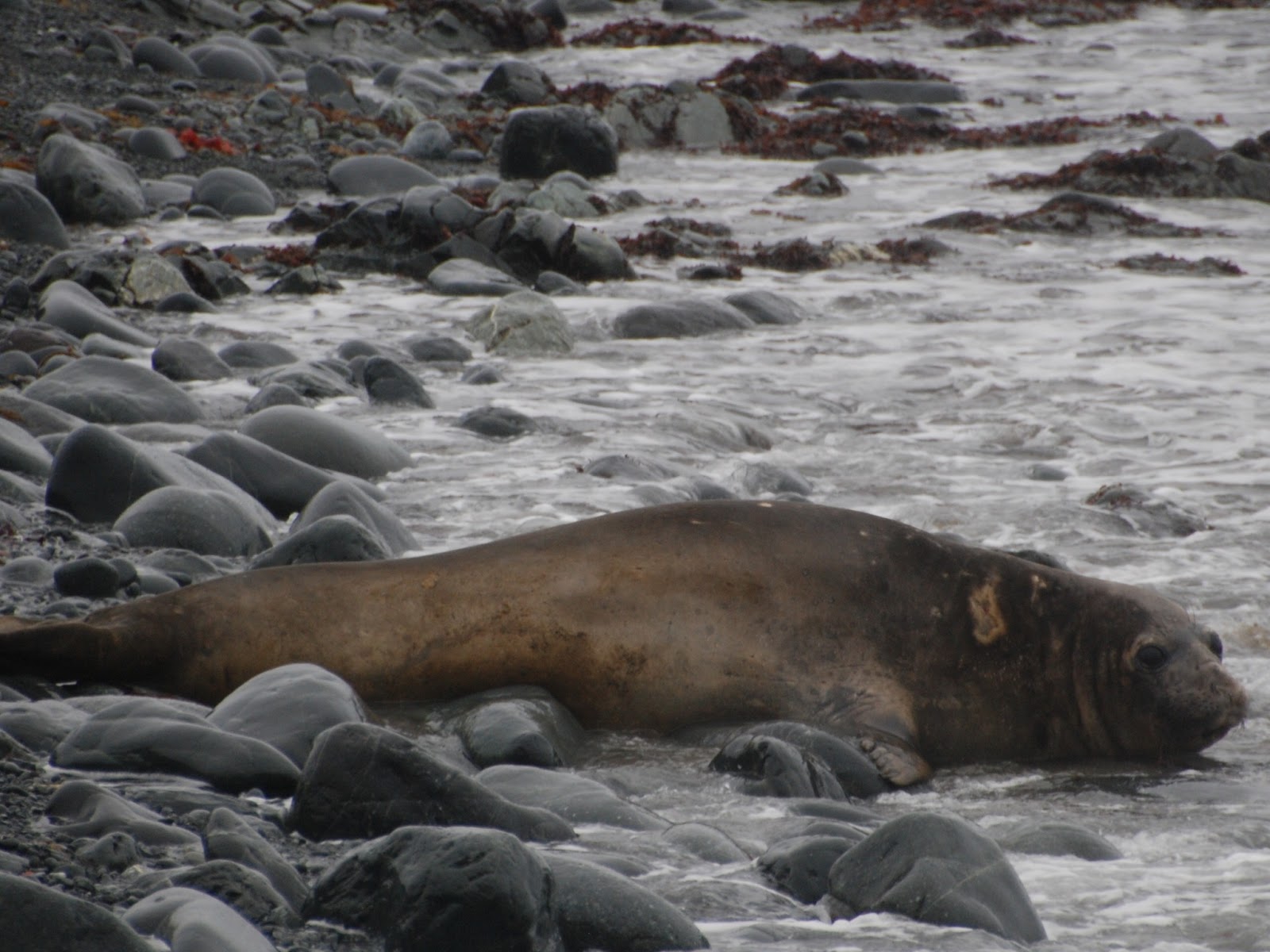
| an elephant seal wallowing on the beach amid the tussock grass while he moults |
 |
| A zodiac landing of passengers from our ship |
 |
| Me on Macquarie Island. Fashion is not high on the priority list in Antarctica |
 |
| Some King penguins in conference. Note the piles of kelp in the background on the black sand |
 |
| King penguins on Macquarie Island with our ship in the background |
 |
| A King penguin chasing a skua away. But the skua will not go far. They are extremely persistent, waiting for any sign of a weak spot which will allow them to move in for a kill and a feast. |
 |
| Part of the ancient Royal penguin rookery |
 |
| The "digesters" in which the penguins were boiled down for their oil |
 |
| And this is where we are now, in the pack ice nearing the Ross Sea in Antarctica. |
MORE PICTURES OF MACQUARIE ISLAND
 |
| Me all bundled up on Macquarie Island. Actually it was not at all cold---it was far colder in London! |
 |
| Gentoo penguins in the foreground amongst the tussock grass, some new breed of red penguins behind them and then to see and the jagged volcanic rocks of the coast of Macquarie Island |
 |
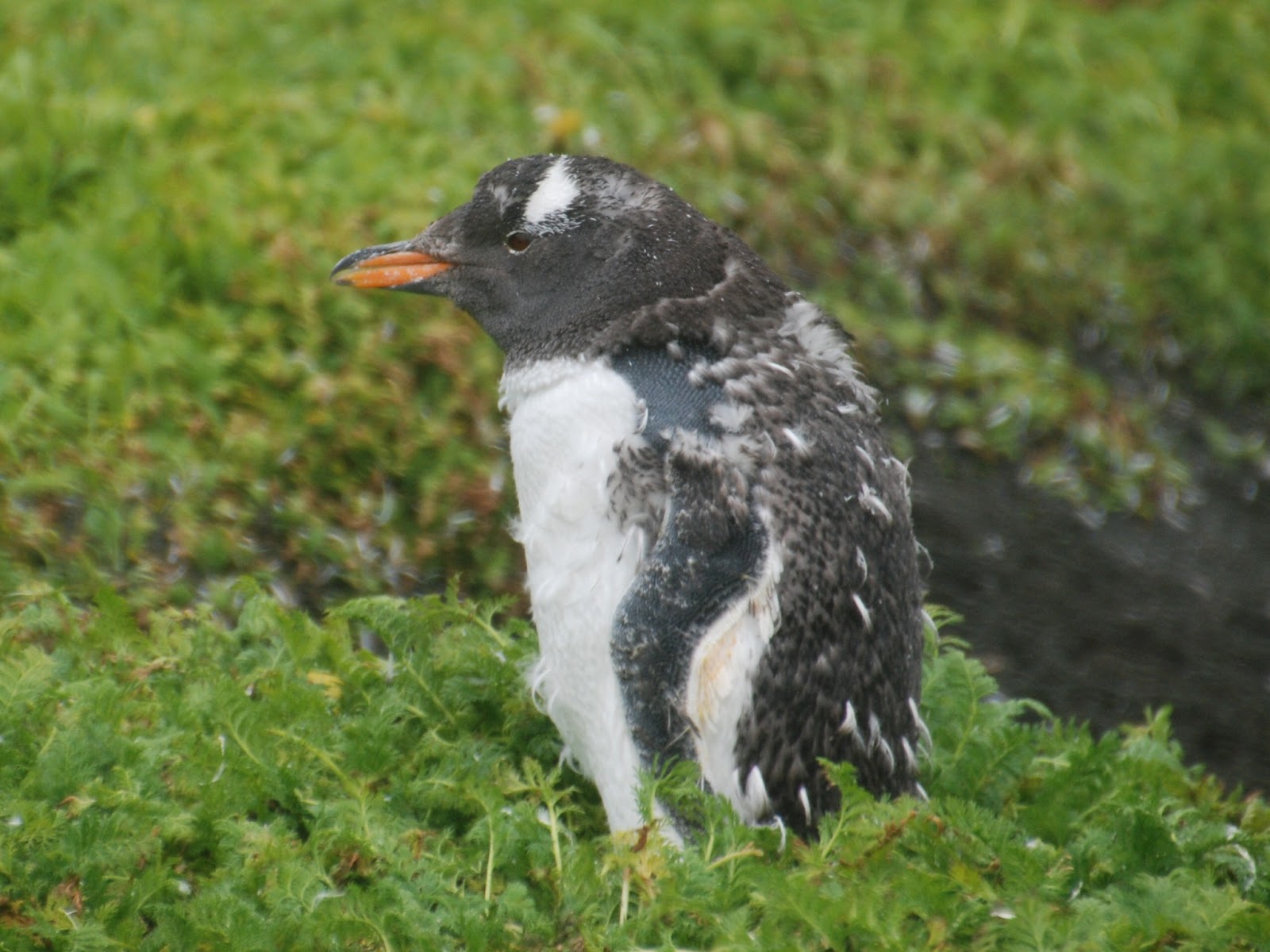
| A moulting gentoo penguin. He looked really fed up |
 |
| King penguins marching onto the beach from their fishing trip |
 |
| A skua, eating a dead penguin. The skuas are fearless, persistent, scavengers and predators. They sit next to the penguin colonies waiting to pick off a weak or young penguin--the hyenas of the Antarctic. |
 |
| A nice comfortable wallow for the moulting elephant seals |
 |
| A female elephant seal ready to head out to sea for a snack. The females are much much smaller than the males. The males have a huge nose like a shortened elephant trunk and weigh up to 3000 kilos. The females have a regular, quite pretty face and only weigh between 300 and 900 kilos (!) |
 |
| A swimming king penguin. They love to "porpoise" diving and surfacing around the ship. |
 |
| This is pillow lava from the undersea formation of Macquarie which was then squeezed up to the surface through a rift in the continental plates. ( Also bull kelp, which is found all over the beaches) |
 |
| This is the so called Macquarie cabbage, one of the indigenous plants which are reestablishing themselves now that the invasive rabbits have been exterminated. Apparently it is rich in vitamin C and so was sought after by sailors and whalers to prevent scurvy |
 |
| March of the red penguins across Macquarie Island |
 |
| A phalanx of elephant seals with gentoo penguiins behind and bull kelp in front |
 |
| These are rock-hopper penguins. True to their name they nest on the steep and rock-strewn slopes of Macquarie and we couldn't get close. |
 |
| King penguins teaching the young to swim and hunt in the sheltered rock pools |
 |
| Penguins are very curious and unafraid. These king penguins will come right up to you if you sit down at their level |
 |
| This is a king penguin rookery. The brown ones in the front are year-old chicks in their "Russian fur coats" of down which they will soon shed as they grow proper feathers underneath. |
 |
| Note the tiny chick sheltering under its parent. The king parents incubate their egg on their feet and keep the new chick fed, warm and safe on their feet until the beginning of the winter.Then they leave the chick to fend for itself over the winter and return to it in the spring. |
 |
| The parents will still feed the year old chick if it has survived the winter on its own. |
 |
| Royal penguins, found only on Macquarie Island |
 |
This is the royal penguin rookery. They have a crest of yellow and orange feathers (see previous picture)
|
 |
| These are royal penguins. The young are different from the young of the kings in that their "Russian fur coats" are greyer and they have a white front. |